

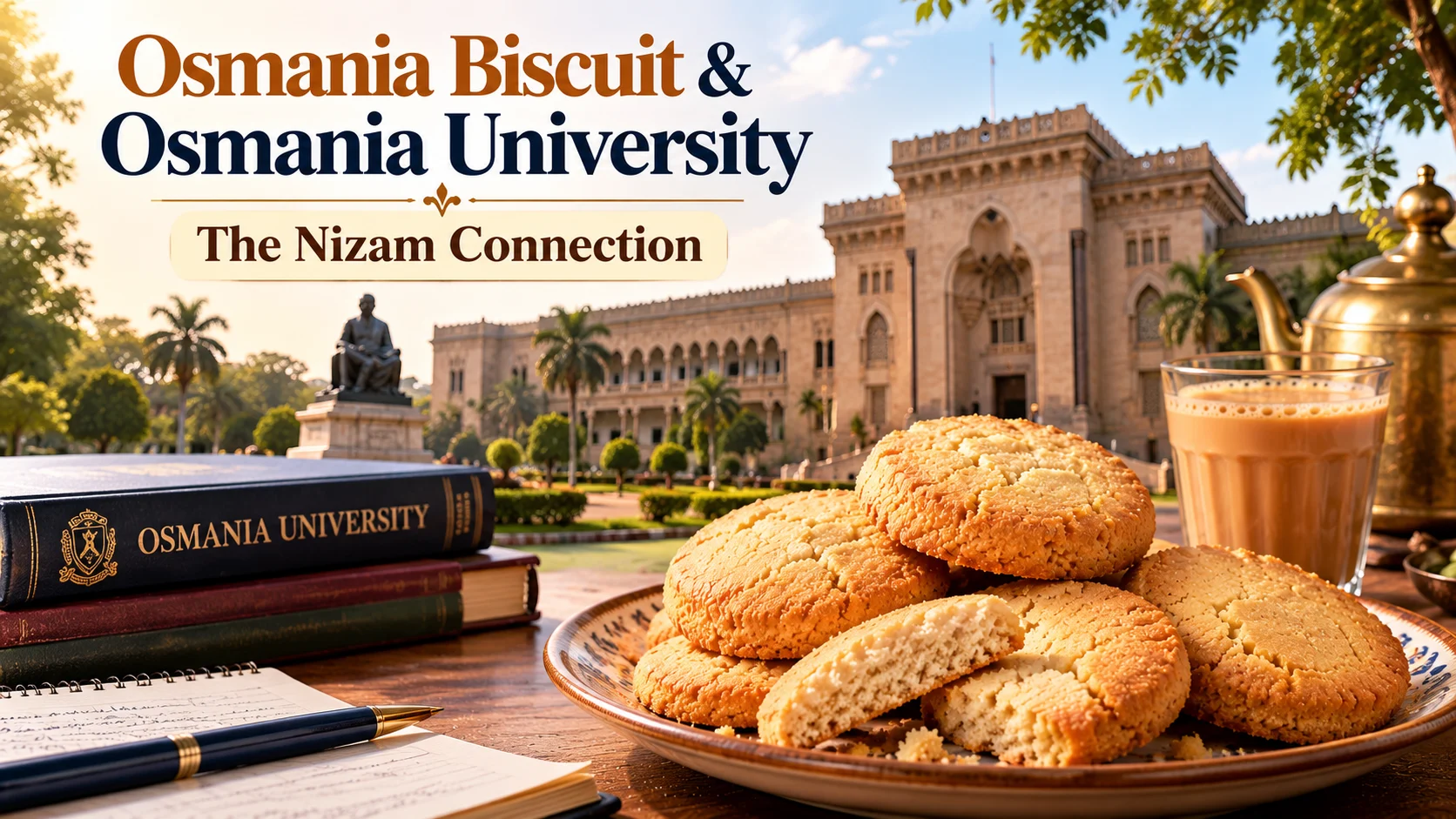
Key takeaways
- The biscuit and the university are both linked to Mir Osman Ali Khan, the last Nizam of Hyderabad.
- The biscuit’s exact origin is not proven. Three popular accounts exist, and all lead back to the Nizam’s Hyderabad.
- Its signature is a sweet-and-salty taste with a soft, crumbly texture, best with Irani chai.
- You can order fresh ones online from Osmania Biscuit, wherever you study.
If you study at Osmania University, you see the name every day. Yet the same word is printed on a hospital and on Hyderabad’s favourite tea-time snack, the Osmania biscuit. Understanding why tells you a lot about the city you live in.
One ruler, three “Osmania” names
Mir Osman Ali Khan was the seventh and last Nizam of Hyderabad, and he ruled until 1948. In 1937, Time magazine described him as the richest man in the world. Many of the city’s best-known institutions date from his rule, including these three:
How the biscuit got its name
Nobody has proved the exact origin, so treat these as popular accounts rather than settled facts. Honest history means saying so.
1. The Abids bakery account
The Nizam is said to have loved the biscuits from a popular bakery in Abids. The owners began calling them “Osmania”, and a car was reportedly sent each day to collect them.2. The hospital account
Osmania General Hospital is said to have created an easy-to-digest, energy-giving food for patients. The biscuit then took the hospital’s name and spread to city cafés.3. The royal kitchen account
Another story says court chefs first made it for the Nizam and his guests. Some writers doubt this version, so it is the least certain of the three.After the Nizam’s rule
When the princely state ended in 1948, independent bakeries and Irani cafés kept the biscuit alive. Today almost every Hyderabad bakery makes its own version.Want the complete story? Read the full history of the Osmania biscuit.
What makes the taste special
Most tea biscuits are only sweet. The Osmania biscuit adds a pinch of salt, and that contrast is its signature. It is soft and crumbly rather than hard, so it melts quickly in hot tea. It is made from simple ingredients: flour, sugar, ghee or butter, milk solids and salt. See what goes into a good one in this ingredients guide.
| Feature | Osmania biscuit | Typical sweet tea biscuit |
|---|---|---|
| Flavour | Mildly sweet with a salty edge | Sweet |
| Texture | Soft, crumbly, melts in tea | Often crisp or hard |
| Best moment | Evening chai, guests, gifting | Anytime snack |
| Cultural link | Hyderabad and the Nizam era | Usually none |
What to pair it with
| Drink | How it tastes with Osmania |
|---|---|
| Irani chai | The classic. Creamy, sweet chai against the salty biscuit. |
| Milk tea | Gentle and comforting. Good for quiet evenings. |
| Black coffee | The salt softens the bitterness. |
| Warm milk | Soft and mild. A favourite with kids and grandparents. |
Dunking tip: Count two seconds, then eat. Any longer and the biscuit falls apart in the cup.
The student chai-break guide
For generations, Hyderabadis have paired Osmania biscuits with Irani chai in the city’s old cafés. For students, it makes a simple study-break ritual because it is light, quick and easy to share. Pick your situation below for a quick suggestion.
Tap an option to see a suggestion.
Or follow this simple routine:
- Study for 25 to 45 minutes. Put your phone away and finish one topic or one question paper.
- Take a 10-minute chai break. Step away from your desk with a cup of tea and a couple of biscuits.
- Dunk for two seconds. Enjoy it slowly instead of eating while you read.
- Review before you restart. Write down three points you remember, then begin the next topic.
Exam-season tip: A biscuit is a treat, not a meal. Keep eating proper food, drink water and protect your sleep.
Miss the taste of Hyderabad?
Whether you study on campus or live far away, order fresh Osmania biscuits online.
Visit Osmania BiscuitCommon myths, cleared up
Myth: It is named after the university.
Not directly. The usual account says it is named after the Nizam, who also founded the university. A second account links it to the hospital.
Myth: Everyone agrees where it began.
They don’t. There are three popular accounts, and none is proven.
Myth: It is just a sweet biscuit.
It is sweet and salty, and that balance is why people love it.
Myth: Every Osmania biscuit tastes the same.
Recipes vary by baker. Some add cardamom and some use more ghee or butter.
Frequently asked questions
Is Osmania biscuit named after Osmania University?
Not directly. Both are linked to the last Nizam, Mir Osman Ali Khan.
Who founded Osmania University?
It was founded in 1918 under Mir Osman Ali Khan, the seventh Nizam of Hyderabad.
Why does it taste salty and sweet?
It is baked with sugar plus a pinch of salt, which balances the sweetness.
What is it eaten with?
Traditionally Irani chai. It also suits milk tea, coffee or warm milk.
Where can I buy Osmania biscuits online?
Order from osmaniabiscuit.in. For more on the culture, read our post Osmania Biscuit: The Story, Taste and Culture.
Origin accounts in this article are traditional and unverified.