

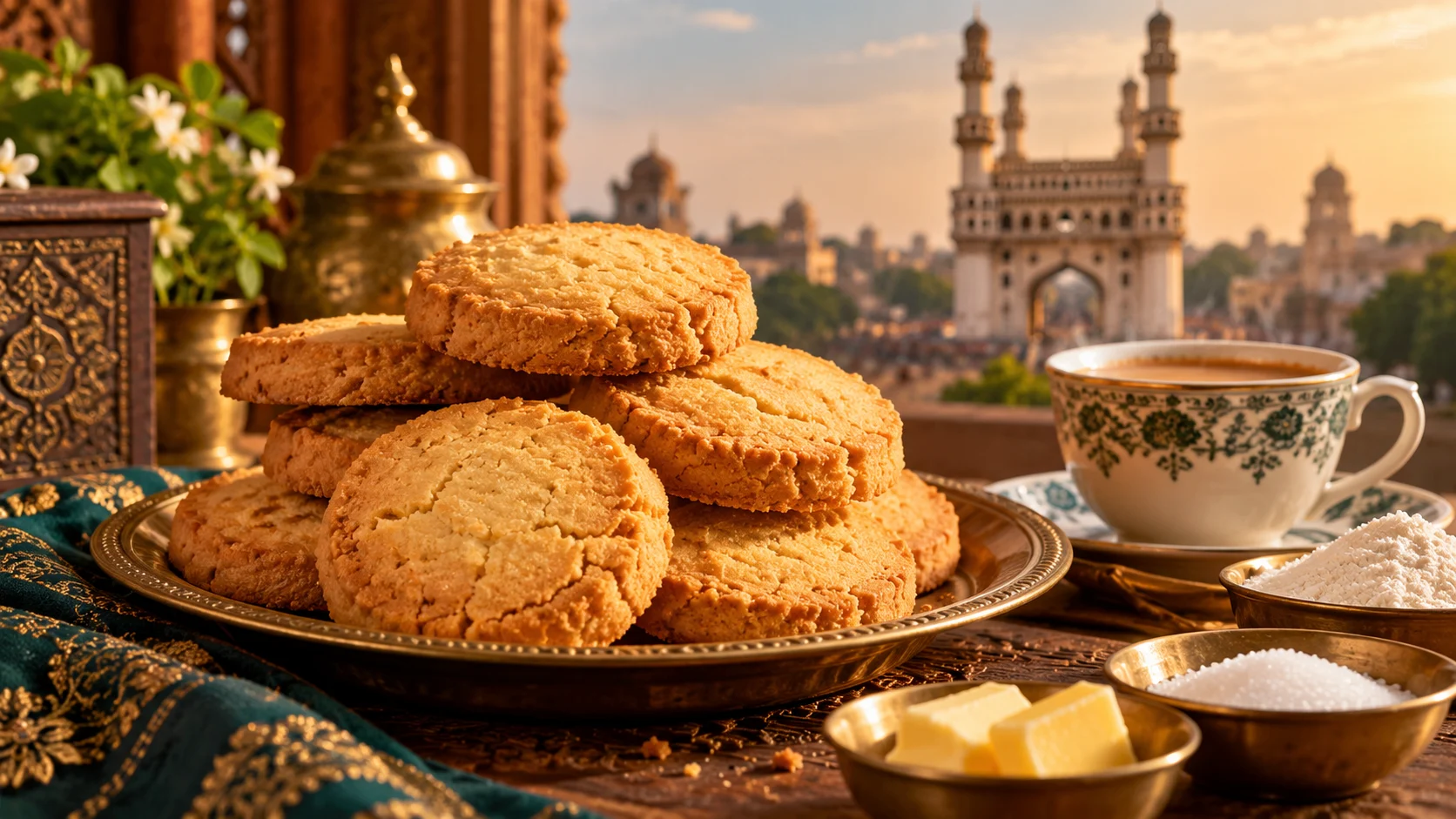
If you have ever sat in a Hyderabadi Irani café with a cup of steaming chai, you have probably had a plate of Osmania biscuits beside it. Golden, buttery and gently salty, this little biscuit carries the flavour of the old city. Here is its story, taste, a simple home recipe and where to enjoy it.
What is an Osmania biscuit?
The Osmania biscuit is a light, buttery tea biscuit from Hyderabad. It is known for its balance of sweet and salty flavours, a soft crumbly texture and a mild, milky aroma. Unlike very sweet cookies, it is made to go with tea and never overpowers the cup.
Round, flat and golden-brown, with slightly darker, crisp edges.
Crumbly and soft inside. It melts quickly when dipped in hot chai.
Made as a tea-time companion, mild enough to match strong Irani chai.
History of the Osmania biscuit
The biscuit is widely believed to be named after Mir Osman Ali Khan, the last Nizam of Hyderabad. Popular accounts say it was created as a snack to suit his taste. From there its story runs through the city’s food culture:
Linked to Mir Osman Ali Khan, which gave the biscuit its name and royal reputation.
Hyderabad’s bakers adopted the recipe and made it a daily staple.
Persian immigrants served it with chai and bun maska, making it an everyday ritual.
A favourite souvenir and tea snack across India, sold in bakeries and online.
Good to know: like many food origin stories, details vary between sources. The Nizam connection is simply the most commonly told version.
Ingredients and taste
Every bakery keeps its own recipe, but most Osmania biscuits use this simple base:
- Maida for a light crumb
- Butter or ghee for richness
- Sugar for sweetness
- Milk for softness
- Pinch of salt for balance
- Cardamom or vanilla optional
The salt is the secret. It balances the sugar and keeps you reaching for another biscuit. The texture is lighter and more delicate than a typical hard biscuit.
Why it goes so well with chai
Strong, creamy and slightly sweet, with a rich milky body.
Mildly salty with an open crumb that soaks up tea without collapsing fast.
The salty edge cuts through the creaminess of the tea. Dip for two seconds, not five. This pairing is a daily ritual in Hyderabad, whether it is a morning break, an evening gathering or a rainy-day treat.
Make Osmania biscuits at home
- Cream. Beat 100 g butter with 70 g sugar until pale and fluffy.
- Mix. Add 2 tbsp milk and a pinch of salt, then fold in 200 g maida with half a teaspoon of baking powder.
- Rest. Let the soft dough sit for 15 minutes, then roll it to about 6 mm thick.
- Cut. Stamp out rounds and place them on a lined tray.
- Bake. Bake for 15 to 20 minutes until golden. Cool fully so they turn crisp.
Where to buy and enjoy them
The classic setting, served with hot chai.
Ask for a fresh batch and buy by weight.
Popular Hyderabad souvenirs that stay fresh for weeks.
Handy outside Hyderabad. Check the baking date.
Visit our dedicated guide at osmaniabiscuit.in for the history, flavours and where to find them. We keep it updated for future visitors.
Visit the Osmania Biscuit guideFrequently asked questions
Why is it called Osmania biscuit?
It is commonly linked to Mir Osman Ali Khan, the last Nizam of Hyderabad.
Is Osmania biscuit sweet or salty?
Both. It is mildly sweet with a pinch of salt.
What is the best way to eat it?
Dipped in hot Irani chai or milk tea.
How long do they stay fresh?
In an airtight container they usually stay good for a few weeks.
Final thoughts
The Osmania biscuit carries Hyderabad’s history in a single bite. Enjoy it at an Irani café, gift a tin or bake a batch at home. For more details, read our complete Osmania biscuit guide.