

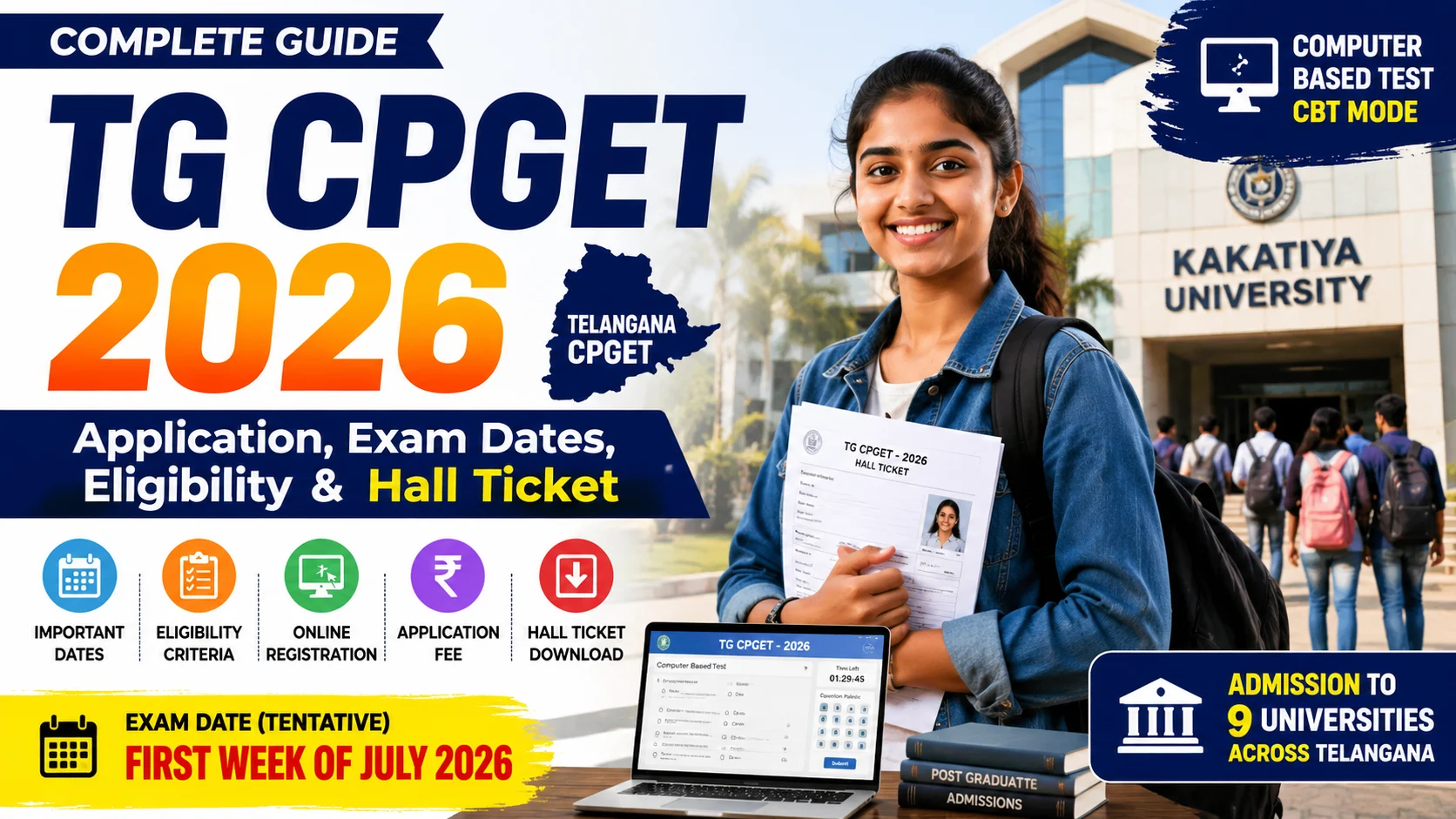
Last Updated: May 19, 2026 | Exam Conducting Body: Kakatiya University on behalf of TGCHE
If you are a graduation final year student in Telangana dreaming of a seat in a top government PG college, TG CPGET 2026 is your gateway. This is not just another exam guide. This is the only page you need to bookmark right now because we have covered everything: exact dates, registration steps, fee details, exam pattern, subject-wise eligibility, participating universities, test zones, and what happens after the exam. Read this fully before you apply.
What is TG CPGET 2026?
TG CPGET stands for Telangana Common Post Graduate Entrance Test. It is a state-level entrance exam conducted by Kakatiya University, Warangal, on behalf of the Telangana State Council of Higher Education (TGCHE), Hyderabad. The exam gives you admission into M.A., M.Sc., M.Com., M.Ed., M.P.Ed., MCJ, and several other PG and PG Diploma courses offered at nine universities across Telangana for the academic year 2026-27.
The exam is conducted in Computer Based Test (CBT) mode, which means you appear at a test centre and answer on a computer screen. No pen and paper. No offline option.
In 2025, 62,821 candidates registered and 51,587 qualified. The competition is real, and preparation matters. But first, you need to complete the application correctly.
TG CPGET 2026 Important Dates at a Glance
These are the official dates released by the Convener, Prof. Rajender Katla, Kakatiya University. Do not miss any of them.
| Activity | Date |
|---|---|
| Notification released | 15th May 2026 (Friday) |
| Online registration starts | 15th May 2026 (Friday) |
| Last date to apply (without late fee) | 10th June 2026 (Wednesday) |
| Last date with late fee of Rs. 500 | 14th June 2026 (Sunday) |
| Last date with late fee of Rs. 2,000 | 18th June 2026 (Thursday) |
| Application correction window | 16th to 19th June 2026 |
| Finalization of test centres | 24th June 2026 (Wednesday) |
| Hall ticket download begins | 28th June 2026 (Sunday) |
| Exam date (CBT mode) | First week of July 2026 (tentative) |
| Preliminary answer key release | 17th July 2026 (Friday) |
| Last date to raise objections on key | 19th July 2026 (Sunday) |
| Result declaration | To be announced later |
Pro tip: Always apply before June 10 and avoid the late fee entirely. The correction window (June 16-19) is your last chance to fix any mistakes in your application, so save your login credentials carefully.
TG CPGET 2026 Registration Fee
The fee varies by category and number of subjects chosen.
| Category | Fee for 1 Subject | Fee per Additional Subject |
|---|---|---|
| OC / BC (General / OBC) | Rs. 800 | Rs. 450 |
| SC / ST / PH (Divyang) | Rs. 600 | Rs. 450 |
Payment can be made online through Credit Card, Debit Card, Net Banking, or at any TG Online Centre physically. There is no offline application mode. Once you pay, you get a Registration ID that you must save for all future logins.
Participating Universities in TG CPGET 2026
Nine universities across Telangana participate in this exam. Your rank in TG CPGET makes you eligible for admission to campus, constituent, and affiliated colleges of all these universities.
- Osmania University, Hyderabad
- Kakatiya University, Warangal
- Telangana University, Nizamabad
- Mahatma Gandhi University, Nalgonda
- Palamuru University, Mahabubnagar
- Satavahana University, Karimnagar
- Jawaharlal Nehru Technological University, Hyderabad (JNTUH)
- Veeranari Chakali Ilamma Women’s University, Hyderabad
- Dr. Manmohan Singh Earth Sciences University, Kothagudem
This is huge. One entrance test, nine universities, hundreds of colleges. That is the power of TG CPGET.
Who Can Apply? TG CPGET 2026 Eligibility Criteria
Before filling the form, confirm your eligibility. The eligibility check happens not at the application stage but during admission, so you must do this yourself.
General eligibility for most PG courses (Arts, Social Sciences, Commerce, Science):
You must have passed your Bachelor’s degree with at least 40% marks or equivalent CGPA. For SC/ST candidates, just passing the qualifying exam is sufficient. There is no upper age limit for TG CPGET 2026.
Note that candidates who completed their degree in a single subject via open or distance education mode are not eligible. Similarly, you cannot apply for the same PG course you have already completed.
Faculty-wise minimum qualification summary:
| Faculty | Minimum Marks Required |
|---|---|
| Arts | 40% or equivalent CGPA (pass for SC/ST) |
| Social Sciences | 40% or equivalent CGPA (pass for SC/ST) |
| Commerce | 40% or equivalent CGPA (pass for SC/ST) |
| Science | 40% or equivalent CGPA (pass for SC/ST) |
| Education (M.Ed.) | B.Ed. with 55% (50% for SC/ST/BC) |
| Education (M.P.Ed.) | B.P.Ed. with 55% (50% for SC/ST/BC) |
Important note for B.E./B.Tech. graduates: You are NOT eligible for M.Sc. Computer Science, M.Sc. Mathematics, or M.Sc. Electronics. However, you ARE eligible for M.Sc. Geo-Informatics and M.Sc. Food Science & Technology. B.Sc. (MLT) graduates are eligible for M.Sc. Biochemistry and M.Sc. Microbiology specifically.
Complete List of Subjects and Subject Codes
TG CPGET 2026 has entrance tests for 40 subjects and admissions for 46 subjects. Here is the full subject list organized by faculty.
Faculty of Arts
| Code | Subject |
|---|---|
| 11 | M.A. Ancient Indian History, Culture & Archaeology (AIHCA) |
| 12 | M.A. Arabic |
| 13 | M.A. English |
| 14 | M.A. Hindi |
| 16 | M.A. Marathi |
| 17 | M.A. Persian |
| 18 | M.A. Sanskrit |
| 19 | M.A. Telugu |
| 20 | M.A. Urdu |
| 21 | M.A. Islamic Studies |
| 22 | M.A. Linguistics |
| 23 | M.A. Philosophy |
| 24 | M.A. Theatre Arts |
Faculty of Social Sciences
| Code | Subject |
|---|---|
| 31 | M.A. Economics |
| 33 | M.A. History |
| 34 | M.A. Journalism & Mass Communication |
| 35 | M.Lib.I.Sc. (2 years) / B.Lib.I.Sc. (1 year) |
| 37 | Master of Social Work (M.S.W.) |
| 38 | Master of Human Resource Management (MHRM) |
| 39 | Master of Tourism Management (MTM) |
| 40 | M.A. Political Science |
| 41 | M.A. Psychology |
| 42 | M.A. Public Administration |
| 43 | M.A. Sociology |
Faculty of Commerce
| Code | Subject |
|---|---|
| 51 | Master of Commerce (M.Com.) |
Faculty of Education
| Code | Subject |
|---|---|
| 56 | Master of Education (M.Ed.) |
| 57 | Master of Physical Education (M.P.Ed.) |
Faculty of Science
| Code | Subject |
|---|---|
| 61 | M.Sc. Botany |
| 62 | M.Sc. Chemistry |
| 63 | M.Sc. Computer Science |
| 64 | M.Sc. Electronics |
| 65 | M.Sc. Geography |
| 66 | M.Sc. Geo-Informatics |
| 67 | M.Sc. Geology |
| 68 | M.Sc. Mathematics |
| 69 | M.Sc. Physics |
| 70 | M.Sc. Statistics |
| 71 | M.Sc. Zoology |
| 72 | M.Sc. Biochemistry / Environmental Science / Forensic Science / Fermentation Technology / Genetics / Microbiology (BCESFSFTG&M) |
| 73 | M.Sc. Biotechnology |
| 74 | M.Sc. Nutrition & Dietetics |
| 75 | M.Sc. Food Science & Technology |
| 76 | M.Sc. Psychology (Kakatiya University only) |
| 77 | M.Sc. Sericulture (Kakatiya University only) |
| 78 | M.Sc. Data Science |
Subjects whose schedules will be released separately if needed: Arabic, Marathi, Persian, Theatre Arts, Electronics, and Sericulture.
TG CPGET 2026 Exam Pattern
This is one of the most searched topics and we will explain it clearly.
Standard exam pattern (all subjects except the special ones below):
| Parameter | Details |
|---|---|
| Mode | Computer Based Test (CBT) |
| Duration | 90 minutes |
| Total Questions | 100 |
| Total Marks | 100 |
| Question Type | Objective / Multiple Choice (MCQ) |
| Negative Marking | None |
| Minimum cut-off (OC/EWS/BC) | 25% (25 marks out of 100) |
| Minimum cut-off (SC/ST) | No minimum cut-off |
The question paper contains 3 to 4 varieties of objective items including analogies, classification, matching, and comprehension-based questions alongside the standard multiple choice. All questions come only from the official syllabus released on the website.
Special exam pattern for M.Sc. Biochemistry, Environmental Science, Forensic Science, Fermentation Technology, Genetics, and Microbiology (Code 72 – BCESFSFTG&M):
| Part | Subject | Marks |
|---|---|---|
| Part A | Chemistry | 40 |
| Part B | One optional Life Science subject from B.Sc. level (Physics/Botany/Zoology/Biochemistry/Genetics/Microbiology) | 60 |
| Total | 100 |
Special exam pattern for M.Sc. Biotechnology (Code 73):
| Part | Subject | Marks |
|---|---|---|
| Part A | Chemistry | 40 |
| Part B | Biotechnology | 60 |
| Total | 100 |
Tentative Examination Schedule (Day-wise)
The exams are spread across 8 days with three slots per day: 9:30 AM to 11:00 AM, 1:00 PM to 2:30 PM, and 4:30 PM to 6:00 PM.
| Day | 9:30 AM to 11:00 AM | 1:00 PM to 2:30 PM | 4:30 PM to 6:00 PM |
|---|---|---|---|
| Day I | M.A. Economics (31) | M.A. Telugu (19) | M.Sc. Psychology (76), M.Sc. Data Science (78) |
| Day II | M.A. Journalism & Mass Comm. (34) | M.P.Ed. (57) | MTM (39), M.Sc. Geo-Informatics (66) |
| Day III | M.A. Political Science (40) | M.Lib.I.Sc./B.Lib.I.Sc. (35) | M.Sc. Geography (65) |
| Day IV | M.A. Pub. Admin. (42), M.Sc. Zoology (71) | M.A. Hindi (14), M.A. Sanskrit (18), M.A. Urdu (20) | M.A. Philosophy (23), M.Sc. Geology (67) |
| Day V | M.A. English (13) | M.Sc. Physics (69) | M.Sc. Food Science & Tech (75), M.A. Linguistics (22), M.Ed. (56) |
| Day VI | M.A. History (33), M.Sc. Chemistry (62) | M.Sc. Computer Science (63), M.Sc. BCESFSFTG&M (72) | MSW (37) |
| Day VII | M.Com. (51), M.Sc. Botany (61) | M.Sc. Statistics (70), M.Sc. Nutrition & Dietetics (74) | M.A. Islamic Studies (21), MHRM (38) |
| Day VIII | M.A. Psychology (41), M.Sc. Biotechnology (73) | M.A. AIHCA (11), M.Sc. Mathematics (68) | M.A. Sociology (43) |
Check the exact dates for your subject once hall tickets are released on June 28, 2026.
List of Test Zones for TG CPGET 2026
You can choose your preferred test zone at the time of application. The 12 test zones are:
- Hyderabad West (Kukatpally, Patancheru and surrounding areas)
- Hyderabad North (Medchal, Gandimaisamma, Old Alwal and surrounding areas)
- Hyderabad East (Mallapur, Ghatkesar and surrounding areas)
- Hyderabad South (L.B. Nagar, Hayathnagar, Karmanghat and surrounding areas)
- Adilabad
- Karimnagar
- Khammam
- Kodad
- Nalgonda
- Mahabubnagar
- Warangal
- Nizamabad
Test centres within each zone are finalized by June 24, 2026, and your exact centre will appear on your hall ticket.
How to Apply for TG CPGET 2026 Step by Step
The official website is cpget.tgche.ac.in. Here is exactly what you do:
Step 1: Visit the official website Go to cpget.tgche.ac.in or kakatiya.ac.in. Look for the TG CPGET 2026 Registration link on the homepage.
Step 2: Pay the application fee Click on “Application Fee Payment.” Enter your name, date of birth, mobile number, email ID, qualifying exam details, and hall ticket number of your degree exam. Choose your payment mode (Debit Card/Credit Card/Net Banking). After payment, you will get a Registration ID. Save this immediately.
Step 3: Fill the application form Log in using your Registration ID, registered mobile number, and date of birth. Fill in all personal and academic details carefully. Upload scanned copies of:
- Latest passport size colour photograph
- Your signature
- Caste certificate (if applicable)
- EWS certificate (if applicable)
- Income certificate (if applicable)
- Aadhaar number
- PWD certificate (if applicable)
Step 4: Select your subjects and test zone Choose the subject(s) you want to appear for and your preferred test zone. If you add more than one subject, pay Rs. 450 extra per subject.
Step 5: Review and submit Before clicking submit, carefully read through every entry. The University can cancel your admission at any stage if details are found incorrect. Take a printout after submission.
Step 6: Note your login credentials You will need them to download hall tickets, rank cards, and access other communications. No physical copy will be sent to you by post.
Documents Required for Application
Keep scanned versions of these ready before starting the form:
- Recent passport size colour photograph
- Signature (white background)
- Caste/Community certificate (SC/ST/BC candidates)
- EWS certificate (if applying under EWS category)
- Income certificate (from MRO/Tahasildar, dated on or after 01.04.2026)
- Aadhaar card number
- PWD certificate (for Persons with Disabilities)
What Happens After the Exam? Result and Counselling Process
Answer Key: Released on July 17, 2026 on both official websites. If you feel an answer is wrong, you can raise an objection at Rs. 200 per objection. If your objection is valid, the fee is refunded within 7 working days after results are published. The last date to raise objections is July 19, 2026.
Result: Date to be announced later. Results will be available only on the official websites. No personal intimation by post or email.
Tie-breaking: If two candidates get equal marks, preference is given first to the older candidate (by age), then to the one with a higher percentage in the qualifying exam.
Counselling: The process is entirely web-based. After results, qualified candidates will have to upload their certificates online for verification, then exercise web options choosing their preferred courses and colleges in order. Provisional allotment is based on rank, category, and preference. Candidates who are allotted a seat must pay the fee online and download the admit card. The counselling schedule will be announced after results.
Documents needed at counselling:
- CET Rank Card (downloaded and self-attested photograph affixed)
- CET Hall Ticket
- Transfer Certificate from the last attended institution
- Original/provisional degree certificate
- Consolidated marks memo of qualifying exam
- SSC/10th certificate
- Community certificate (SC/ST/BC as applicable)
- EWS certificate (for academic year 2026-27 if applicable)
- Income certificate (issued by MRO/Tahasildar on or after 01.04.2026)
- NCC/CAP/PWD certificates (if claiming special category)
Reservation of Seats
Understanding the reservation structure helps you plan your strategy during counselling web options.
Local vs Non-local: 85% of seats in every course are reserved for local candidates of the Osmania University area. The remaining 15% are unreserved.
Community-wise reservations:
| Category | Reservation Percentage |
|---|---|
| Scheduled Caste (SC) | 15% |
| Scheduled Tribe (ST) | 10% |
| Backward Class Group A | 7% |
| Backward Class Group B | 10% |
| Backward Class Group C | 1% |
| Backward Class Group D | 7% |
| Backward Class Group E | 4% (subject to court decision) |
| EWS | As per Telangana Government Orders |
Women candidates: A minimum of 33.33% of available seats in each course within each category are reserved for women.
National Integration Quota (NIQ): 20% supernumerary seats in campus and constituent colleges are available for candidates from states other than Telangana, provided they completed their school and college education outside Telangana.
Special category seats: NCC, CAP (Widow/Children of Armed Personnel), and Persons with Benchmark Disability get one seat per every 30 seats in each subject.
Important Rules Every Candidate Must Know
There are a few rules that can trip up unprepared candidates. Read these carefully.
Eligibility is verified only at admission, not during the exam. Even if you qualify in the entrance test, you can be denied admission later if you do not meet eligibility conditions. Always confirm your eligibility before applying.
No personal communication from the university. Hall tickets, rank cards, schedules, and all information is available only on the websites. Check them regularly.
Employed candidates must resign from their job or secure leave for the entire duration of the PG course, since all these are full-time programmes. A certificate to this effect is required at admission.
Biometric data (thumb impression and photograph) will be captured at the entrance test centre. This data is used during hostel and admission processes.
Malpractice leads to criminal prosecution. Photo morphing, impersonation, and copying are treated as criminal offences under Indian law.
Revaluation is not permitted after final results are declared.
Attendance: Once admitted, you must maintain at least 75% attendance in lectures and practicals. The Vice Chancellor can condone up to 10% on medical grounds only.
Hostel accommodation is limited and not guaranteed just because you got a college seat. Hostel is not available to those who have previously completed any PG course, those in self-finance/payment/NIQ seats, or those in evening courses.
TG CPGET 2026 Frequently Asked Questions
Is there negative marking in TG CPGET 2026? No. There is absolutely no negative marking. Attempt all 100 questions.
What is the minimum cut-off to qualify? OC/EWS/BC category candidates need at least 25 marks out of 100 (25%). SC/ST candidates have no minimum cut-off.
Can I apply for multiple subjects? Yes. You can apply for more than one subject by paying an additional Rs. 450 per extra subject.
Is there an age limit for TG CPGET 2026? No age limit has been prescribed for appearing in the exam. However, age limits for fee/scholarship reimbursement are governed by Telangana Government rules.
When will the hall ticket be released? Hall tickets will be available for download from June 28, 2026. Download from the official websites only.
Can I correct my application form after submitting? Yes. The correction window is open from June 16 to 19, 2026. Use this carefully as it is the only opportunity.
Are 5-year Integrated M.Sc. admissions through TG CPGET 2026? No. A major change for 2026: admissions to 5-year Integrated M.Sc. programmes will be made through DOST 2026, not TG CPGET.
What is the official website? cpget.tgche.ac.in and kakatiya.ac.in are both official websites.
Quick Preparation Strategy for TG CPGET 2026
Since you found this article early, you still have time to prepare effectively.
The exam has 100 MCQ questions of 90 minutes duration. That gives you 54 seconds per question, which is comfortable. Focus on your core subject deeply. Download the official syllabus from cpget.tgche.ac.in once it is published and follow it strictly. The question paper is framed only from the official syllabus, so do not waste time on topics outside it.
Solve previous year TG CPGET/OUCET papers. The pattern and question style remain similar year to year. Pay special attention to analogies, classification, and matching type questions since these appear consistently in the paper.
For science students applying for M.Sc. Biotechnology or BCESFSFTG&M subjects, your Chemistry preparation for Part A (40 marks) is crucial. A strong performance in Part A can significantly boost your total score.
Aim for 65+ marks if you want a seat in a campus college at Osmania or Kakatiya University. For affiliated college seats, 40 to 55 marks is usually sufficient depending on your subject.
Final Checklist Before Applying
Here is everything you need to do right now:
- Confirm you meet the eligibility criteria for your chosen subject
- Keep your scanned photograph, signature, and documents ready
- Make sure your mobile number and email ID are active and will remain so
- Have a valid payment method ready (Debit/Credit/Net Banking)
- Register on cpget.tgche.ac.in before June 10 to avoid the late fee
- Save your Registration ID immediately after payment
- Complete the full application form after payment
- Take a printout of your submitted application
- Note the correction window: June 16 to 19 if you need to fix anything
- Download hall ticket from June 28, 2026 onwards
For all updates on TG CPGET 2026, bookmark ouprephub.in. We will publish the latest news on result dates, answer key, counselling schedule, and cutoff analysis as soon as they are officially announced.
Official Website: cpget.tgche.ac.in | Conducting Body: Kakatiya University, Warangal on behalf of TGCHE, Hyderabad | Convener: Prof. Rajender Katla